
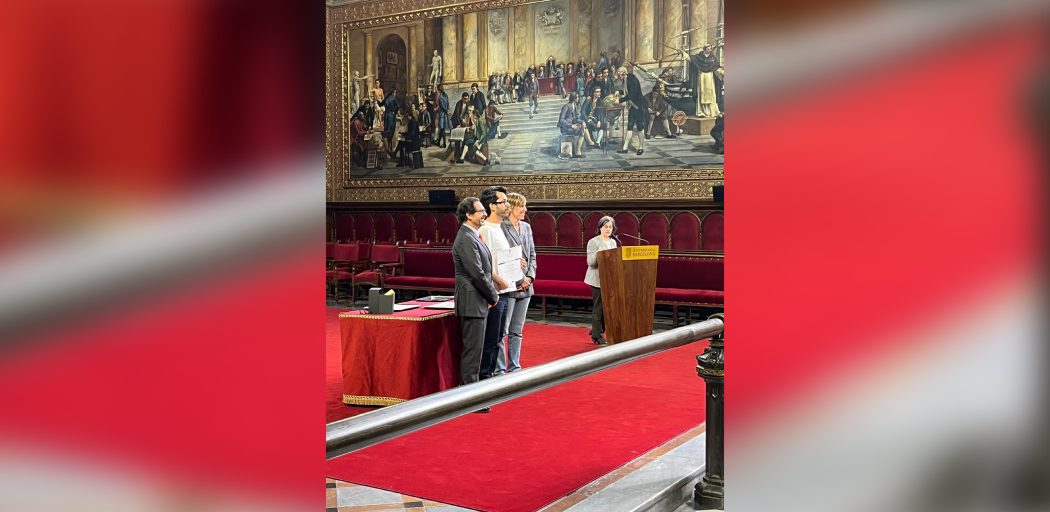
The thesis by Jordi Duran, Extraordinary Doctorate Award of the University of Barcelona for the 2023–2024 academic year
The Extraordinary Doctorate Award is one of the highest academic distinctions granted by the university to recognize doctoral theses that stand out for their excellence, originality, and scientific impact.
Jordi Duran is a professor of Stage in Public Spaces and Theatre Management and Production in the Bachelor’s Degree in Performing Arts – Acting.
This award not only evaluates the quality of the submitted work, but also the researcher’s academic trajectory during their doctoral studies. In practical terms, this recognition provides a decisive boost to an academic career, as it grants additional points in accreditation processes and in access to scholarships and competitive postdoctoral positions. For the institution, in this case the University of Barcelona, awarding these prizes highlights its ability to produce cutting-edge research and to train top-level research talent.
The thesis is a study that adapts and applies performance practice to the context of compulsory secondary education, and it is explored for its potential to reconfigure pedagogical and care relationships, as well as attention to diversity within the educational community. It investigates the integration of other forms of knowledge into the performing arts, such as a/r/tography from a performative perspective, critical pedagogy, education for social justice, queer theories, and intersectionality.
To carry this out, it deploys different creative processes, artistic actions that become theatrical production and a means of study through which both the context and the working team itself are examined. As research based on the performing arts, it is offered as a performative device that seeks to “do things” with theatre: beyond describing realities, it creates them, along with new representations, contexts, and experiences. Furthermore, the methodologies and subjects of study in this research evolve as it develops. Thus, this thesis reports three major shifts that occurred during the two years of fieldwork carried out in a highly complex secondary school.
The first occurred when the reality of the school was encountered; the second when it was observed to what extent the conditions under which teachers carried out their work were decisive in students’ education; and the third when, through a research-creation project, a shift was made toward the teaching community and the study was moved from the school to the rehearsal room.
Finally, this is a thesis that also presents itself as a space that advocates for the possibilities of theatrical and performative practice in social research and that, at a formal level, seeks to push beyond the limits of the academic and infiltrate other spaces such as non-formal training centers, outreach activities in civic centers, performing arts venues, and, ultimately, society at large.
The title of the thesis is The Mutant Classroom: an investigation into the movements that take place when performance practice becomes part of pedagogical relationships and attention to diversity in compulsory secondary education. It is supervised by Fernando Hernández-Hernández and Judit Vidiella Pagès.