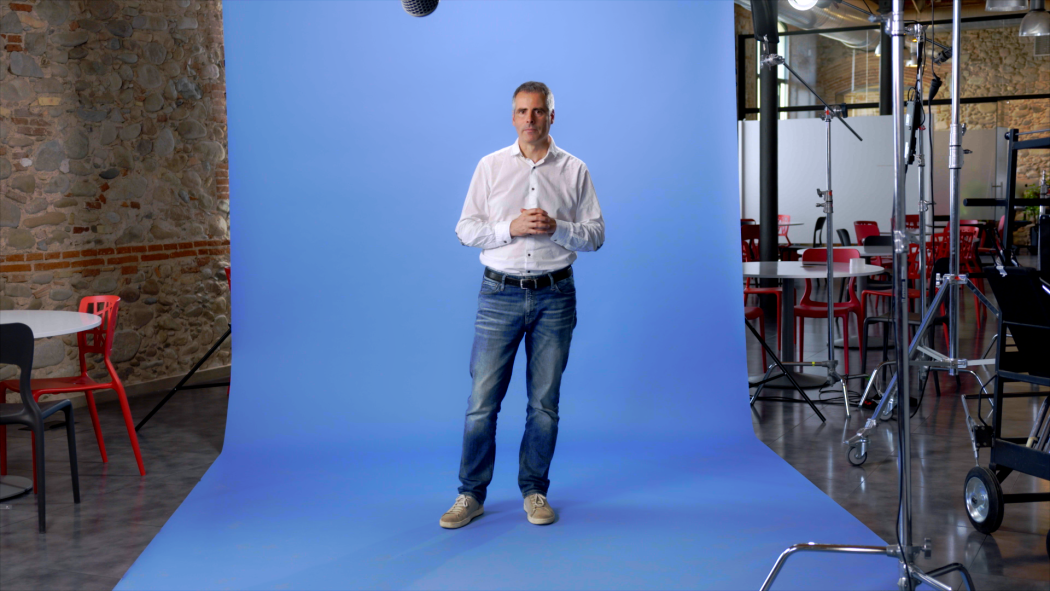
Miquel Bisbe, Director of the University Centre for the Arts: “ERAM should always feel like home”
Miquel Bisbe Fraixinó, Director of the ERAM University Centre for the Arts, looks back on the origins of the project, its evolution since 1998 and the future challenges of arts education. A journey shaped by innovation, interdisciplinarity and the ambition to bring the arts into the university.
In 1998, ERAM began with a pioneering educational programme focused on audiovisual and multimedia communication. Its first cohort consisted of just twelve students, and the project had very limited resources. Today, the ERAM University Centre for the Arts, affiliated with the University of Girona (UdG), offers university degrees in Audiovisual Communication and Multimedia, Performing Arts and Fashion. It has also expanded its academic offer with a Master’s Degree in Interaction Design and research initiatives such as the Playful Living Lab.
At the heart of this journey is Miquel Bisbe, the Centre’s Director, who has witnessed the project’s transformation first-hand. In this interview, he reflects on how ERAM was founded, the challenges it has overcome, its establishment as a university centre and the vision that should guide its future.
The Joan Bosch Private Foundation: the origins of the project
ERAM is part of a foundation. How did this structure come about?
ERAM initially operated within a limited company called Escola de Gestió Empresarial. As the project grew and became increasingly connected to the University of Girona, we realised that, in order to develop university-level programmes, it would be beneficial to have a non-profit structure.
Eduard Bosch, owner of Escola de Gestió Empresarial, decided to establish the Joan Bosch Private Foundation in memory of his brother.
The foundation took over all of ERAM’s activities and became the structure that made it possible to develop and consolidate the project over the years. All the value generated has remained within this organisation, with the aim of continuing to grow the educational project on a non-profit basis.
The early years: a pioneering commitment to multimedia communication
ERAM was founded in 1998. How did the idea of creating an educational project of this kind come about?
The origins were somewhat accidental. After returning from military service, I resumed my teaching career at the Escola de Gestió Empresarial de Girona. At the time, some of the courses offered there were being discontinued following the establishment of the University of Girona, and I was asked to oversee their closure.
It was then that Manel Caro, told me about a project they were developing in Olot: interactive CD-ROMs combining audiovisual and multimedia content. It was a very innovative proposal at the time. They were working with a team of lecturers, but lacked the support needed to expand the project and wanted to relocate it to Girona.
I met with Francesc Font, who has been a lecturer at ERAM ever since and was the person behind the educational concept. He explained the proposal: combining audiovisual production with multimedia and beginning to work with an interdisciplinary approach to different media in order to communicate an idea.
From there, we designed an initial one-year programme and launched what we remember as the beginnings of ERAM.
What were those first steps like?
We started with virtually no budget. Eduard Bosch, who was in charge of Escola de Gestió Empresarial, offered us the available facilities and resources, but with one condition: he would not invest any money, and we would have to make the project work ourselves.
We prepared some leaflets and distributed them around Girona, as the internet was not yet a common communication tool at the time. The first cohort consisted of twelve students. The teaching team included Francesc Font, Manel Caro, Lluís Baldomero, who was responsible for the audiovisual component, and other specialised professionals.
One of the things I remember most about those early days is that the first students were very brave. They came because they wanted to learn about something they were passionate about and because they wanted to work in that field. They valued vocation and motivation more than having a recognised qualification. At the time, choosing a new and relatively unknown course of study was a significant decision.
What was the main challenge in growing the project?
The biggest challenge is that we have done practically everything without external funding. ERAM has always grown through its own resources. Tuition fees have allowed us to purchase equipment, hire lecturers, improve our facilities and invest in communication. Everything we generated was reinvested in the programmes themselves.
The other major challenge has been continuously adapting to technological changes. We started with CD-ROMs, then came DVDs, websites, social media, AI… Our field is constantly evolving, and this forces us to update our curricula and ensure that our teaching staff stay up to date.
From independent qualifications to official university degrees
How did the transition from the initial courses to university degrees take place?
From the very beginning, we knew we did not want to repeat the previous experience of having a course disappear because it lacked official recognition. That is why we began working with the University of Girona and its foundation to develop university qualifications.
First, we launched the Diploma in Audiovisual Communication and Multimedia and, later, the Graduate Degree in Audiovisual Production and Multimedia (GRAM), a three-year programme that already followed a university-level structure.
However, an independent qualification is not the same as an official degree. This could limit students’ opportunities to access public-sector employment, continue their studies with a master’s or PhD, or pursue an academic career abroad.
For this reason, we looked for ways to facilitate the recognition of our qualifications. We established partnerships with British universities, particularly the University of Lincoln and, later, the University of Northampton. Students could complete three years of study in Girona and then spend an additional year in England to obtain an official British qualification.
Finally, changes to the Spanish university system opened up the possibility of submitting our own curricula for official accreditation. In 2008, we submitted the academic proposal for the Degree in Audiovisual and Multimedia, which enabled us to take the step towards an officially recognised qualification.
What did the partnership with the University of Girona mean for ERAM?
It was a very important step forward. We went from being a centre offering non-official university-level education to becoming part of the university system, with officially recognised degrees.
This meant joining the university pre-enrolment system, adapting to the University of Girona’s academic regulations, meeting teaching staff requirements and developing research activities. It also brought significant growth in student numbers: we went from an average of around thirty-five students to approximately sixty.
Above all, this consolidation opened the door to expanding our academic offer with new degrees.
La Coma Cros: a new home in Salt
Why did you decide to move to the former textile factory of La Coma Cros?
As the programmes grew, the space we occupied at Escola de Gestió Empresarial became too small. We needed facilities that would allow us to continue growing.
Through our connections with other university centres, we learned about the renovation project of the former La Coma Cros textile factory in Salt. We spoke with Salt City Council, and the mayor was very supportive of the idea of bringing university studies to the city.
We signed an agreement with Salt City Council, which provided us with a space of approximately 1,900 square metres. We have gradually renovated and expanded it over the years. The decision was initially driven by the need for more space, but it eventually became a fundamental part of our identity.
Was the move complicated?
Very much so. When we arrived at La Coma Cros, the fire department determined that the building did not meet the necessary safety requirements for educational activities. The City Council had to spend approximately a year finding solutions, including installing sprinklers and a fire safety system.
On top of that, everything coincided with the 2008 financial crisis. Companies and suppliers were closing down, construction work became complicated, and we experienced coordination and management problems. The first cohort of the official degree programme started before the facilities were even finished.
For a year, we had to temporarily use municipal facilities in the building that now houses the Water Museum. We improvised classrooms using walls made of wooden pallets. It was a temporary solution, but it allowed us to get started while construction on our new home was being completed.
How would you describe the relationship between ERAM and Salt?
I think it is interesting to look at it from the opposite perspective as well: how has ERAM influenced Salt? Our presence has helped bring life to the cultural complex of La Coma Cros. We have brought people, movement and activity, helping to attract other projects to the space. Today, it is a place that forms part of the city’s pride.
From audiovisual communication to a university centre for the arts
At what point did ERAM move beyond being a centre focused on audiovisual communication and begin defining itself as a university centre for the arts?
Once we had consolidated the Degree in Audiovisual and Multimedia, we began thinking about what other programmes we could introduce. We realised that our field was not limited to audiovisual communication: we were working with creators and artists.
One of the first additions was the Degree in Performing Arts. The idea was very clear: if we had students working behind the camera, it would be very interesting to also have students working in front of it.
To develop the project, we contacted Salvador Sunyer from Temporada Alta, who put us in touch with Xavier Albertí. He helped us define the academic approach and prepare the programme proposal. Later, Eduard Molner contributed to completing the accreditation process and launching the degree.
The introduction of performing arts was very important because it made us realise that the centre was evolving towards a university project connected to different artistic disciplines.
And how did the Fashion degree come about?
ERAM has always sought to establish connections with social and educational organisations in the Girona area. One of these connections was with Escola Qstura and its director, Sílvia Castelló, who wanted to launch an officially recognised university degree in Fashion.
We had worked together and supported her throughout the process of preparing the programme proposal, but the project encountered numerous administrative and regulatory difficulties. After several attempts, it was put on hold.
I realised that we could join forces and that bringing Fashion into the ERAM project made perfect sense. We were based in a former textile factory, fashion plays a major role in Catalonia’s industrial and creative history, and it was also a field that I was personally very interested in.
We spoke with Sílvia and decided to submit the project together once again. We had to reformulate the proposal several times to adapt it to regulatory changes, but eventually we managed to launch the degree. It was a long and complex process, but today the Fashion programme is fully established.
What motivated the introduction of the Master’s Degree in Interaction Design?
One of the key aspects of consolidating a university project is research. That is why we wanted to bring in lecturers with research experience who could help us develop this dimension.
In this context, we welcomed Ferran Altarriba, a former ERAM student who had built an international career and was pursuing his PhD in the United States. We invited him to return to Catalonia, join our teaching team and create a research laboratory that would draw on his experience.
This is how the Playful Living Lab was born. However, to fully consolidate our research activities and move towards a future doctoral programme, we also needed an official master’s degree.
Together with Ferran Altarriba, we identified Interaction Design as an area with great potential to connect research with our other programmes. We developed an international master’s degree, taught entirely in English, which would allow us to welcome students from other countries and strengthen the centre’s research dimension.
Furthermore, it is a discipline that connects with all the fields we work in. Performing arts increasingly incorporate technology and interaction, while the fashion industry is also undergoing significant developments towards interactive experiences. The master’s degree can become a meeting point between ERAM’s different disciplines.
An interdisciplinary educational model connected to the professional world
What makes ERAM’s educational model different?
For me, one of its most important characteristics is that we offer a genuinely interdisciplinary education. We have always championed a 360-degree perspective within each discipline and have never understood education solely in terms of immediate specialisation.
When someone finishes secondary school and enters university, they are still discovering what interests them and which direction they want their future to take. I believe it is more important for them to acquire a broad foundation, explore different possibilities and develop the ability to adapt to changes in the professional landscape.
This interdisciplinary approach is also reflected in the way we work across degrees. Students can discover other creative fields and develop collaborative projects. Someone who starts studying audiovisual communication might discover 3D; someone who enrols in Performing Arts might find a new calling in stage creation; and a Fashion student might eventually become interested in marketing, pattern-making or garment construction.
Discovery is a fundamental part of the university experience.
What role do industry professionals play in this educational model?
We have always wanted to maintain a mixed teaching staff. On the one hand, we need lecturers who are permanently connected to the centre, conduct research, support students and ensure the coordination and organisation of our programmes.
On the other hand, we need professionals who are actively working in their respective industries. Our fields evolve very quickly, and we cannot teach students about what is currently happening in a company, in the world of acting or in technology applied to fashion without lecturers who are directly involved in those industries.
Approximately half of our teaching staff combine teaching with professional activity. This allows us to connect the content of our programmes with the realities of the creative industries.
What does this interdisciplinary education offer students when they enter the professional world?
It gives them the ability to adapt. When companies approach us looking for students, they often do not ask for highly specific knowledge. Instead, they look for people who are resourceful, creative, proactive, capable of working in teams and able to find solutions.
An interesting example is the Performing Arts programme. People often assume that career opportunities in acting are limited, but students can also work in stage creation, teaching and many other fields. According to the employment data I consulted from AQU, our Performing Arts graduates had an employment rate of 80%.
The idea is that students should not graduate prepared to do just one thing, but rather have a foundation that allows them to pursue different professional paths.
An interdisciplinary educational model connected to the professional world
How would you describe ERAM’s transformation from 1998 to today?
The change has been enormous. When we started, I was responsible for coordinating the project, and we had four lecturers. We worked with one camera, one computer and one cable. Today, we have a much more comprehensive infrastructure, a team of around ten administrative and support staff members, and nearly sixty lecturers associated with the centre.
Our activities have also changed considerably. In the past, we might have organised one event a year; now, something happens every week. We have gained visibility, professionalised our organisation and consolidated our working processes.
Another important change is internationalisation. We have gone from having no international agreements to having fifty-two, and around one hundred students currently participate in exchange programmes. We have also moved from having students mainly from Girona to welcoming students from different parts of the world, including China, South Korea, Argentina, Mexico and other parts of Spain.
What should ERAM never lose, no matter how much it continues to grow?
I believe ERAM should always feel like home. It should be a place where people walk in and feel they are in a safe environment, where they can work, grow and develop.
When you are a student, you might not realise it because you have no other experiences to compare it with. But when you leave, whether to go on an exchange programme or because you have completed your studies, that is when you begin to appreciate how important that place has been to you.
It is this sense of family, community and belonging that we should always strive to preserve.
Artificial intelligence and the future of creative professions
How is artificial intelligence transforming arts education and the programmes offered at ERAM?
Artificial intelligence is another tool, but it is a revolutionary one. When we started, the internet did not exist, there were no social media platforms, and digital tools were very different from those we use today. We have gradually incorporated all these transformations, and now we find ourselves at a similar turning point with artificial intelligence.
The question is not simply how to incorporate new technology, but how to teach people to use it critically and thoughtfully. Companies are looking for people who can work independently, solve problems, demonstrate creativity and initiative, and collaborate effectively. These are human skills that remain essential.
That is why we first need to train our lecturers so they understand these tools and know how to integrate them into our curricula. Then, we need to teach students how to use them to improve their processes and become more productive, without losing their ability to decide what they want to do and why.
I believe the biggest change that may lie ahead is that people will be able to create their own tools and applications tailored to their needs. However, to do so, they need knowledge and critical judgement. That is one of the things we need to teach.
How would you like ERAM to be remembered twenty years from now?
First of all, I would like it to have endured and to be remembered for having been a pioneer in bringing the arts into the university.
A very important part of our leisure time and cultural life is connected to the arts: music, concerts, museums, architecture, theatre and many other experiences. The arts have an enormous presence in society, but they still need greater recognition and prestige within the university environment.
I would like the importance of having paved the way to be recognised twenty years from now, and for institutions to have made an even greater commitment to arts education. I would even like to see these programmes eventually become publicly funded degrees, making them accessible to more people.
That would be one of our greatest ambitions for the future.